


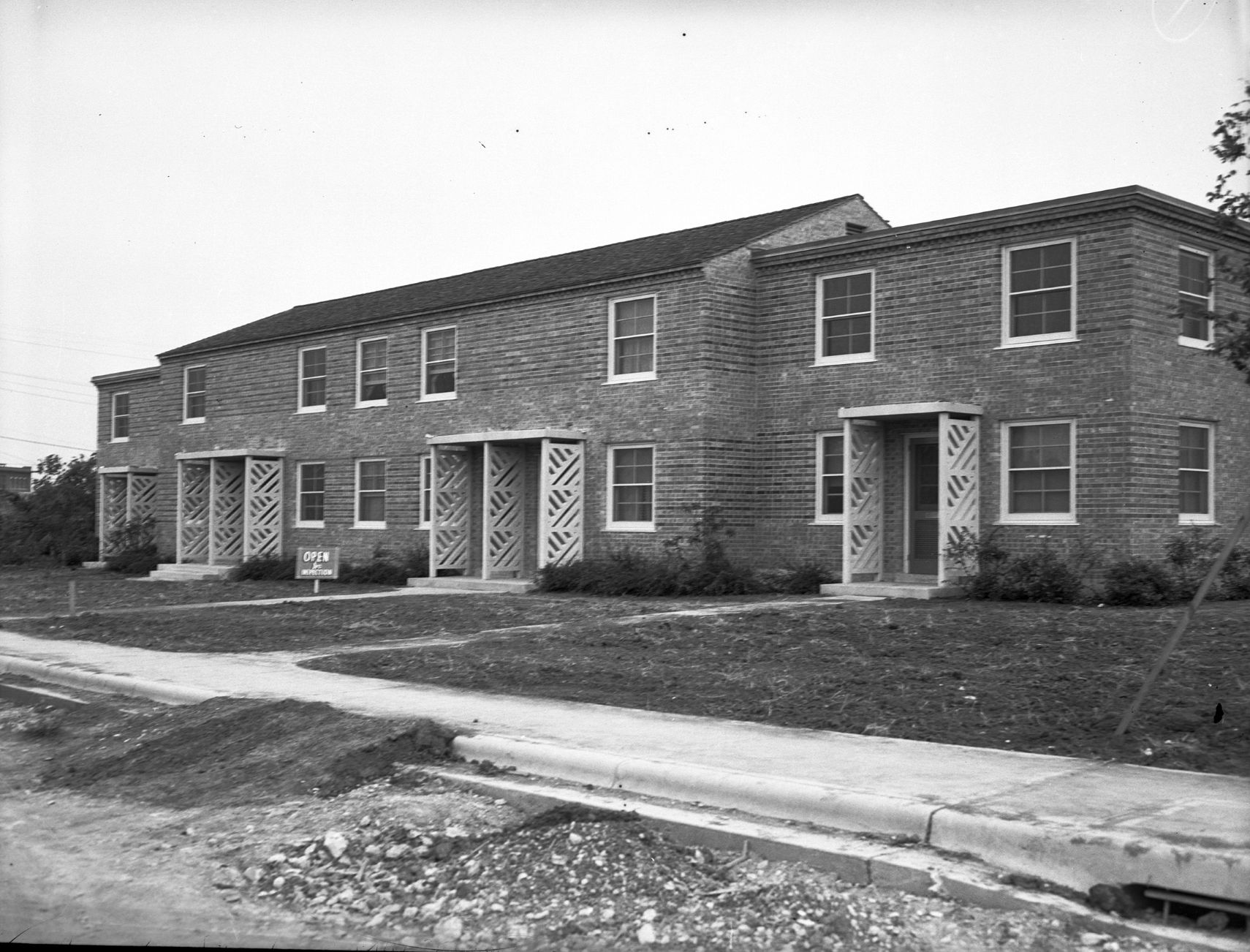

he New Deal-era Butler Place public housing project was a federally subsidized apartment complex east of downtown Fort Worth where residents developed a strong sense of community. Today, hopes exist for a commercial rebirth on the strategically located site. The project, opened in 1940, was one of the Public Works Administration’s 52 public housing projects constructed nationwide in response to the Great Depression. Built on a 20-acre plot, the project was named by local African American civic organizations in honor of Henry Harrison Butler, a Civil War veteran and one of Fort Worth’s first Black educators. The former public housing site, once Fort Worth’s largest, is bounded by I-30, I-35 and Highway 287, east of downtown in Council District 8.
Public housing for a growing metropolis
During the Great Depression, Fort Worth’s population growth outpaced new housing development while many residential areas deteriorated. In 1940, it was reported that 7,400 families lived in “blighted areas” that lacked proper infrastructure, including running water, ventilation and sanitation.
In 1935, the Fort Worth Chamber of Commerce unsuccessfully petitioned the Public Works Administration to construct low-rent housing in Chambers Hill, a predominantly Black neighborhood that contained I.M. Terrell High School (later Carver-Hamilton Elementary School). In 1938, a $2,231,000 contract between the U.S. Housing Authority and the newly created Fort Worth Housing Authority (FWHA) was signed to fund a 252-unit low-income housing project for white families and a 250-unit project for Black families. The latter became the Butler Place housing project, and the white housing became the Ripley Arnold housing project.
Between April and July 1939, 220 “substandard dwellings” in Chambers Hill were cleared for the Butler Place project site. The design of the buildings was “guided by economy and utility” in a “stripped or minimal Colonial Revival style.” Construction on Butler Place began in July 1939 and was substantially completed in August 1940. The first units were leased in September 1940.
Individual units contained one to three bedrooms, living space, a kitchen and a bathroom, with rents ranging from $15.50 to $16.75 per month, slightly less expensive than those at Ripley Arnold. To qualify, families had to have a net income of less than five to six times the rent amount, depending on the family’s number of dependents. In addition to the red-brick apartment buildings, an administrative facility was constructed to house “an 800-square-foot social room and an African American branch of the Fort Worth Library.”
In September 1941, Butler Place housed 803 residents, while more than 500 applicants remained on a waitlist. In 1946, 32 units, intended for Black veterans and their families, were added to Butler Place. Due to increased wages and higher costs of living, rental rates and maximum income limits were raised several times throughout the 1940s to allow residents with higher incomes to continue living at Butler Place and Ripley Arnold.
In 1960, the City Council approved a proposal to build 244 additional units of Black public housing on a 24-acre plot just north of Butler Place. The Butler Place Addition opened in 1963. In 1966, a pedestrian overpass spanning Highway 287 was constructed so Butler Place residents could access the Harmon Field Recreation Center.
By the 1970s, housing quality at Butler Place had deteriorated, and the area was plagued by violent crime and pervasive drug problems. In 1980, Butler Place underwent renovations to provide updated heating systems and insulation, install new bathroom and kitchen appliances and lay tiles to replace concrete floors, among other improvements. Once the decision was made to abandon Butler Place, FWHA relocated Butler Place residents to mixed-income properties throughout the city between 2018 and 2020. The housing project stood vacant after 80 years of use.
Preserving the past for the future
FWHA wants to sell the property to a qualified buyer for redevelopment. The site represents the last large chunk of property suited for development in the downtown corridor. The former Butler Place community is significant to Fort Worth’s history and culture. Under an agreement, portions of the neighborhood will be preserved for future generations. Two buildings and the nearby school that served Fort Worth’s Black community for decades will be preserved as Historic and Cultural Landmarks. Red bricks from the Butler Place property have been saved to create a future public art installation on the property.