


Highway expansion increases capacity and improves mobility for drivers
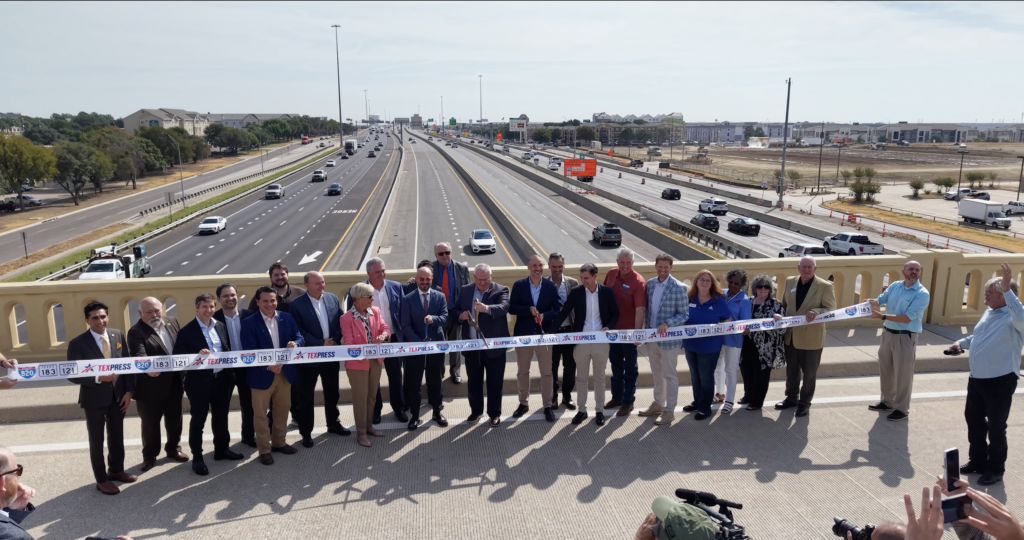
FORT WORTH (September 24, 2026) – TEXpress Highways has completed construction on its North Tarrant Express (NTE) Capacity Improvement Project, expanding 10 miles of the SH 183/121 (Airport Freeway) and Interstate 820 (Loop 820) highway corridors between Euless and Fort Worth. The $414-million project, which began in late 2023, was funded solely through toll revenues, meaning no public-sector or taxpayer money was utilized in the expansion’s design and construction.
The project, which traverses six municipalities in Northeast Tarrant County, has added one free, general-purpose lane in each direction along Loop 820 between Riverside Drive in Fort Worth and Texas Blvd. 26 in North Richland Hills, and one TEXpress managed lane in each direction along Airport Freeway between Bedford-Euless Road in North Richland Hills and FM 157/Industrial Blvd. in Euless. Completion comes months ahead of schedule; originally, the project was slated for completion in early 2027.
Developer NTE Mobility Partners (NTEMP) – made up of Ferrovial, Cintra, Meridiam and APG – initiated construction on the NTE corridor in 2009. At a cost of $2.6 billion, it was the first public-private partnership (P3) project in the state of Texas. The fully reconstructed highway corridor opened in October 2014, nine months ahead of schedule. As part of its original Comprehensive Development Agreement (CDA) with the Texas Department of Transportation (TxDOT) and the state of Texas, NTEMP agreed to expand the NTE highway corridor when certain traffic volume milestones were met.

“Fort Worth is now the 10th largest city in the United States, reflecting the explosive growth in our region and particularly in Tarrant County,” said Pablo Ferrando, CEO of TEXpress Highways. “As more and more businesses and people have moved to this region – which remains one of the most economically robust in the nation – traffic volumes have increased in both the general-purpose main lanes and TEXpress managed lanes, triggering the need for the expansion,” he added.
Average daily traffic along the Airport Freeway and Loop 820 corridors has increased by more than 25 percent since pre-construction levels in 2009. Yet, even with the increase in traffic volume, the average speed along the corridor remains high: an average of 45 mph in the general-purpose lanes and 70 mph in the TEXpress managed lanes, even during peak rush hours. “The short-term pain of construction is outweighed by the tremendous benefit for everyone – commuters, residents, first-responders and others – of being able to get where they need to go more quickly and safely,” said David Salazar, Fort Worth district engineer for TxDOT. “But this is not just a quality-of-life issue; keeping North Texas moving has sustained, positive economic implications that we should not overlook,” he added.
Construction on the capacity improvement project was managed by North Tarrant Infrastructure, a joint venture between Ferrovial Construction and Webber. Most of the construction activities occurred during overnight hours to minimize disruption to drivers and local communities. “Even in the face of periods of inclement weather and construction blackouts due to major events such as the FIFA World Cup, our team still delivered the project well ahead of schedule,” said Ignacio Milans, CEO of North Tarrant Infrastructure. “The design-build model continues to demonstrate the ability to deliver projects in a fraction of the time as compared to traditional funding and construction,” he added.
Texas has been a leader in the development of P3 projects, with projects in North Texas, including the LBJ Express and the Midtown Express, as well as in Houston and Austin. “Texas has clearly demonstrated the value of P3s to the public, and other states are taking notice and adding this tool to their toolboxes,” said Michael Morris, director of transportation and staff director to the Regional Transportation Council. “With the gas tax unchanged in the last 35 years, there simply is not enough money in Texas to keep pace with the infrastructure needed to accommodate a region that will ultimately surpass 12 million people and become the third-largest metropolitan area in the country. Delivering a project quickly that is paid for by the private sector is a win-win for everyone,” he added.

TEXpress Highways recently released a 10-year retrospective on the economic and societal benefits of the P3 model. The case study outlines a $25-billion regional economic impact since the first TEXpress highway corridors opened in 2014, with billions more anticipated in the coming decade.