


Survey Structure and Methodology
Across multiple phases of employer surveys conducted by the Fort Worth Chamber in the fall of 2025, more than one hundred organizations provided input on workforce readiness and hiring conditions across Tarrant County.
Respondents included CEOs, business owners, human resources leaders, and frontline managers, ensuring representation from multiple levels of leadership and operations.
Participating employers represented a diverse mix of industries including manufacturing, logistics, healthcare, construction, professional services, hospitality, and corporate operations. Participating employers reflected the full spectrum of the regional economy, from small and emerging firms to long-established enterprises.


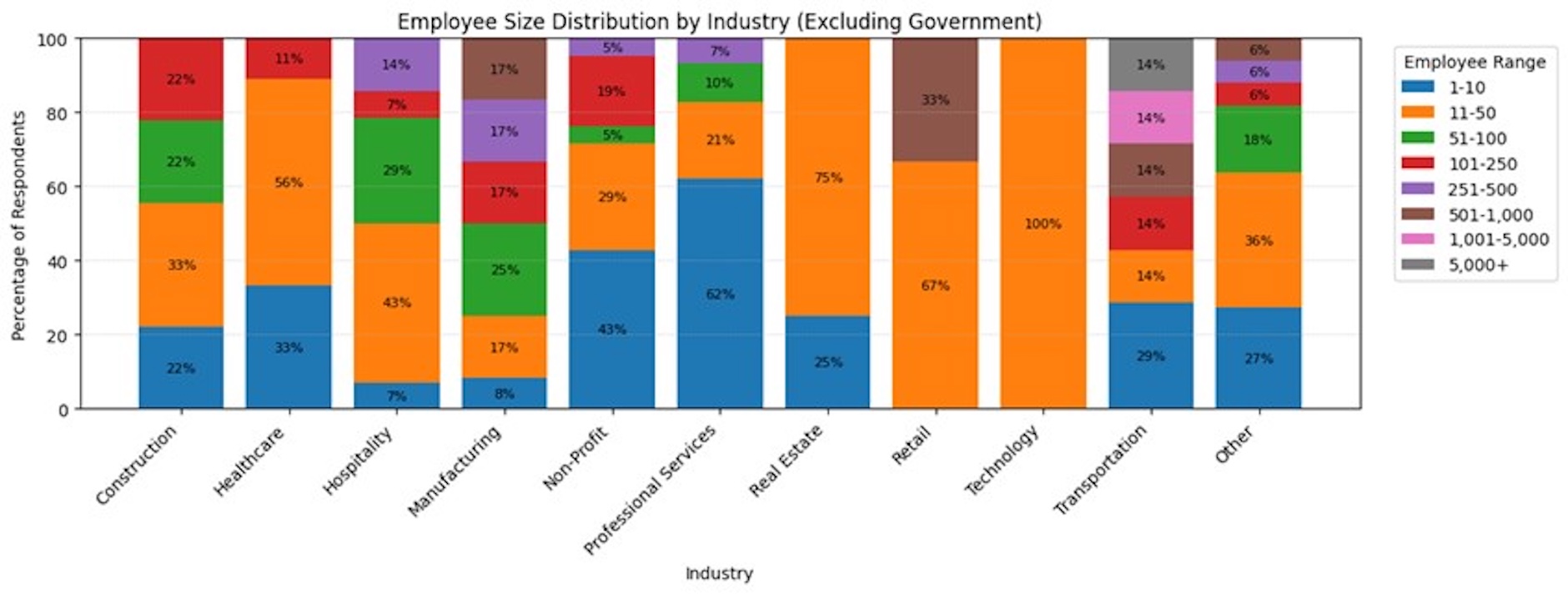
In total, more than 300 individual survey submissions were received across the three phases, offering a well-rounded view of workforce perspectives within and across participating organizations while aligning closely with recent, nationally conducted studies.
The survey was structured to evaluate workforce characteristics using a three-part comparison model. Employers were asked to rate:
- The importance of specific workforce characteristics to their organization’s success.
- The current strength of those characteristics within their existing workforce.
- The difficulty of hiring candidates who demonstrate those characteristics.
By analyzing these measures side-by-side, the surveys reveal where alignment exists and where pressure is building within the workforce system.
For clarity, the identified characteristics can be sorted into two categories:

- People skills (often called “soft skills”, these are non-technical traits and interpersonal human skills)
- Technical skills, degrees, and industry experience
Executive Summary
Across every phase of the survey, people skills consistently ranked as the workforce characteristics most important to organizational success.
Communication, critical thinking, adaptability, emotional intelligence, and reliability were rated above technical credentials in overall importance to organizational success.
There was a strong correlation between the importance of people skills and the perceived difficulty in finding these skills in the labor marketplace.
And while many employers expressed confidence that their current workforce was strong in these skills, a third or more said that their teams were not strong in those skills.

People Skills: Where Expectations and Strain Intersect
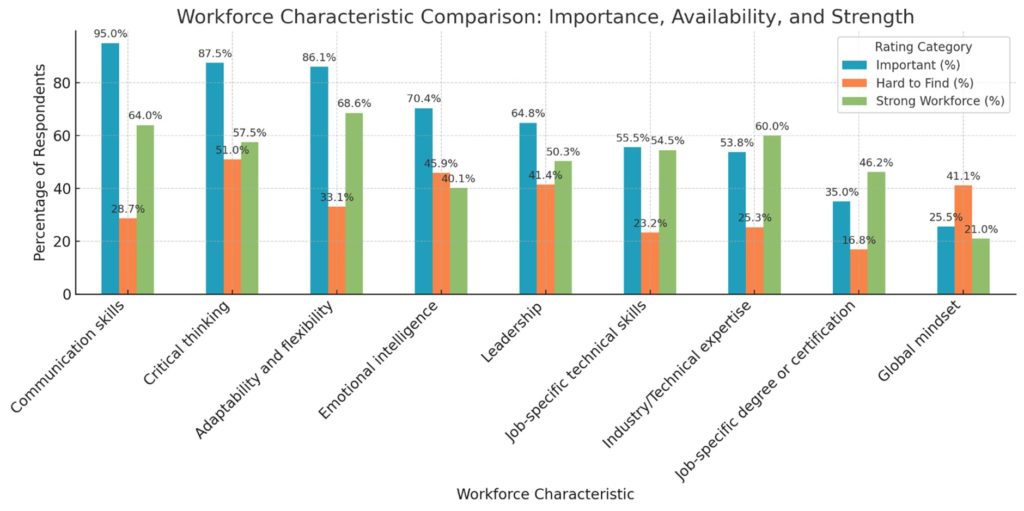
- Communication ranks as the single most important skill across the survey results.
Employers report moderate to strong existing workforce capability in this area, and while hiring difficulty exists, it does not significantly outpace current workforce strength.
Compared to other people skills, communication is relatively easier to source in the labor market and continues to be reinforced by solid internal capability.
Although a gap remains between its high importance and existing strength, communication does not emerge as the primary workforce constraint in isolation. - Critical thinking ranks just below communication in overall importance but operates under greater strain.
Employers report moderate internal capability; however, hiring difficulty nearly matches existing workforce strength, leaving little room to easily replace or expand talent in this area.
While expectations exceed current internal capability, the narrower margin between workforce strength and hiring difficulty suggests that demand for stronger decision-making skills could create increasing pressure over time. - Adaptability emerges as one of the most structurally stable people skills in the current workforce.
It shows a closer alignment between employer expectations and current workforce capability than the other people skills. At the same time, hiring difficulty remains meaningfully lower than existing internal strength, suggesting organizations have greater flexibility to grow or replace talent in this area.
Rather than signaling strain, the data indicates that adaptability is a well-developed and sustainable strength within the workforce system. - Emotional intelligence, the ability to perceive, understand, manage, and regulate emotions in oneself and others, stands out as one of the clearest pressure points among the people skills evaluated.
Although it ranks below communication and critical thinking in overall importance, employers report comparatively lower internal capability alongside notable hiring difficulty.
In contrast to adaptability, where workforce strength exceeds recruitment challenges, emotional intelligence reflects the opposite pattern, with hiring difficulty slightly surpassing current internal strength. This imbalance suggests that organizations cannot rely on recruitment alone to close the gap, positioning emotional intelligence as a development-driven challenge within the workforce system.
When viewed collectively, emotional intelligence and critical thinking represent the clearest areas of structural strain among the people skills analyzed.
Communication remains essential yet comparatively sustainable, serving as a reinforcing competency that underpins the development and application of other people skills. Strong communication enables critical thinking to be effectively expressed, strengthens emotional intelligence in practice, and supports leadership readiness and cross-team collaboration.
The data suggests that workforce strain is not uniform across people skills but is concentrated in relational and cognitive competencies that most directly influence leadership readiness, problem-solving, and overall organizational performance. This gap is especially evident when comparing what employers say they need most compared against what they feel their teams currently deliver, underscoring a critical need for targeted people skill development strategies.
Employers across participating industries face a dual challenge: identifying candidates who already demonstrate strong interpersonal and critical thinking skills while also building internal capacity to develop those competencies over time. The data suggests that recruitment alone will not resolve the pressure points identified in the survey; development strategies must operate in parallel.
Technical Skills, Degrees, and Industry Experience
Technical skills and formal credentials exhibit a notably different pattern.
While employers clearly value industry-specific knowledge and experience, these characteristics rank lower in overall importance when compared directly to people skills. At the same time, internal workforce strength in technical areas is generally reported as moderate to strong.
Hiring difficulty in technical skills exists but is not consistently aligned with the highest pressure points identified in people skills. Additionally, employer commentary across phases indicates a consistent belief that technical competencies can be developed internally when foundational people skills are present.
Organizations frequently report that they are willing and able to train for equipment operation, industry-specific systems, regulatory knowledge, and technical certifications.
However, employers are far less confident in their ability to remediate deficiencies in communication, critical thinking, or emotional intelligence once an employee is onboarded.
The contrast suggests that the region’s workforce challenge is less about credentials and more about readiness behaviors that influence how technical skills are developed and applied.
While these findings were largely consistent across industries, the construction sector stands out as a notable outlier regarding technical skills. Employers in construction reported the highest levels of strength within their existing workforce in terms of industry knowledge and technical expertise. At the same time, they indicated some of the greatest difficulty among all industries in sourcing that same level of expertise in new candidates.
Development and Employer Investment in People Skills
In subsequent survey phases, employers were asked directly whether they believe people skills can be developed. The majority indicated that improvement is possible. However, responses reveal variation in how development occurs.
Larger employers are more likely to report structured professional development efforts, including internal leadership programs, communication workshops, and external training partnerships.
Smaller organizations more often rely on informal coaching, modeling, and manager-driven feedback processes.
Feedback from the healthcare industry strongly emphasized the critical importance of people skills, particularly communication, emotional intelligence, and adaptability. Unlike some other sectors, healthcare respondents did not consistently report significant difficulty in identifying these traits in applicants. However, they made clear that possessing baseline people skills is not sufficient in a field defined by high-stakes human interaction.
Many healthcare institutions are actively exploring innovative approaches to continually strengthen these competencies, particularly within higher education and clinical training environments. For example, programs such as those implemented at Columbia University incorporate professional actors into simulated patient interactions, allowing students to be evaluated on how they navigate difficult conversations, manage emotionally charged situations, and respond to unexpected or extraordinary circumstances. This model reflects a broader recognition within healthcare: technical proficiency must be paired with advanced interpersonal capability, and those skills require intentional, experiential development rather than passive instruction alone.
While belief in development potential of people skills is widespread, structured implementation remains uneven. This suggests that people skills are widely recognized as essential, but infrastructure to support systematic development is still maturing.
Implications for the Labor Market
The findings point first to a skills mismatch rather than a credential deficit. Employers are not signaling a widespread shortage of degrees or baseline qualifications. Instead, they are describing a gap in behaviors and mental frameworks required to navigate modern work environments. This distinction is significant. Traditional education and training pathways may be producing technically qualified candidates, yet employers consistently indicate that readiness is defined more by judgment, communication, and applied reasoning than by credentials alone.
People skills increasingly function as a competitive advantage. There is growing alignment among human resource leaders nationwide that people skills will serve as a defining differentiator in the future workforce, viewed as equally important to, and in some cases more valuable than, technical expertise. As routine tasks are increasingly replaced by artificial intelligence and technology continues to reshape job functions, employers are placing greater value on distinctly human capabilities. Adaptability to learn new technologies, critical thinking to turn new ideas into practical solutions, and ethical judgement to manage the risks associated with AI and data. According to a study conducted by Deloitte, people skill-intensive occupations will account for two-thirds of all jobs by 2030.
The data also suggests a reframing of workforce readiness. Employers appear increasingly willing to train for technical skills when foundational people skills are present. This represents a departure from older hiring models that prioritized hard credentials first and attempted to coach professional behaviors later. Adaptability, communication, and critical thinking are emerging as the entry point for long-term value creation. Employees who demonstrate these capabilities are viewed as more scalable and more resilient in dynamic environments.
The traits described as hardest to find—critical thinking, emotional intelligence, and communication—are the same competencies that drive innovation, collaboration, and leadership development. The pressure in these areas reflects broader shifts in how work itself is evolving.
Finally, certain sectors may experience heightened exposure to these constraints. Industries that rely heavily on customer interaction, cross-functional coordination, and rapid responsiveness—such as hospitality, education, and healthcare—depend disproportionately on people skill utilization. Where those competencies are under strain in the broader labor market, these sectors may feel the impact more acutely.
External Barriers to Talent Attraction
Across the three phases of the Talent Survey, respondents were also asked about their organization’s ability to attract talent to their Fort Worth location. Nearly half identified traffic and commute time, along with the cost of housing, as meaningful barriers to recruitment.
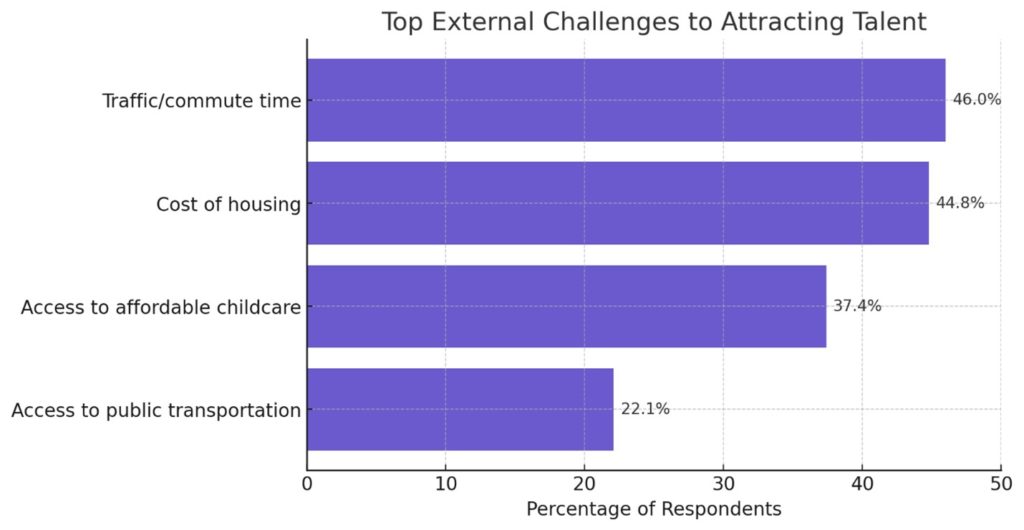
A closer review of follow-up responses adds important context. More than half of respondents described traffic as a moderate to serious challenge, most often pointing to highway congestion and extended travel times or distances. Although respondents represented 26 different zip codes across Tarrant County, organizations located in the downtown 76102 zip code most frequently identified traffic and commute time and affordable childcare as their primary barriers to attraction.
Housing costs were also frequently cited as a moderate challenge. When asked to clarify their concern, many employers indicated that the issue was not simply housing prices alone, but the relationship between wages and housing affordability. Additionally, the longer commute times resulting from limited housing options near employment centers.
Childcare was generally described as a moderate concern. Employers most often cited cost as the primary issue, rather than the overall quality or availability of providers.
Public transportation, however, emerged as less of a constraint than initially assumed. When respondents were asked to rank its severity on a five-point scale, the majority indicated it was not a challenge, and only a small portion described it as moderate or severe. Among those who did express concern, limited geographic coverage was the most noted limitation.
Final Thoughts on People Skills and Technical Skills
The side-by-side comparison between people skills and technical skills points to a clear conclusion: the greatest workforce pressure is concentrated in people skills rather than in technical capability.
Employers consistently rank human skills as the most important drivers of performance. Yet the gap between importance and strength is widest in areas tied to adaptability, emotional intelligence, and critical thinking.
Technical skills remain important and sometimes difficult to source, but they are generally viewed as trainable. People skills, particularly emotional intelligence and critical thinking, represent the areas where recruitment and development capacity are most constrained.
Taken together, the data suggests that strengthening the region’s workforce competitiveness will depend less on increasing credentials alone and more on reinforcing the foundational competencies that enable collaboration, decision-making, and long-term organizational performance.
The story in the data is not about scarcity of talent. It is about alignment between employer expectations, existing workforce capability, and the systems designed to develop both.
Acknowledgements
The Fort Worth Chamber extends its sincere appreciation to all who participated in this multi-phase workforce survey series. The time and thoughtfulness contributed by CEOs, business owners, human resources leaders, and frontline managers made this analysis possible. With over 300 individual submissions across the survey phases, respondents provided not only data, but meaningful perspective drawn from real-world operational experience. Their willingness to candidly share both strengths and challenges supports the region’s ability to respond with clarity and purpose.
We are also grateful to the partner organizations and community stakeholders who helped distribute, promote, and champion participation in the survey process: Fort Worth HR and Workforce Solutions for Tarrant County. Expanding employer engagement required active collaboration, and their support ensured that the findings reflect a broad and representative cross-section of industries and company sizes across Tarrant County.
Finally, special recognition is due to the Fort Worth Chamber’s Talent Committee. Committee members dedicated significant volunteer hours to shaping the survey framework, refining question design, and thoughtfully interpreting the results as they developed. Their expertise and commitment ensured that the survey moved beyond data collection and toward meaningful insight. The depth and quality of this report reflect their steady guidance and shared belief that workforce alignment is a regional priority.
This work is the result of collective investment, and it stands as a testament to the business community’s commitment to strengthening Fort Worth’s talent pipeline for the future.
