

On Friday, April 10, I wrote a column in The Business Press about FOMO (Fear of Missing Out) vs. JOMO (Joy of Missing Out). After composing my own version, I queried two Artificial Intelligence (AI) resources (ChatGPT and Claude) so I might compare their creativity and grasp of the subject. My conclusion: AI writing is improving. We’re better served to compose our own content and use AI to augment, rather than replace, our personal touch.
Please find below the ChatGPT version. My next column will feature the Claude version. I’m just helping you make sure that you are not… missing out!
There was a time—not that long ago, though it now feels like the rotary-phone era—when missing out simply meant… missing out. You didn’t know what you missed, so you moved on with your life, perhaps with a sandwich. Enter FOMO, the “fear of missing out,” a modern condition fueled by glowing rectangles that ensure you are never more than three seconds away from discovering that someone, somewhere, is having a better time than you.
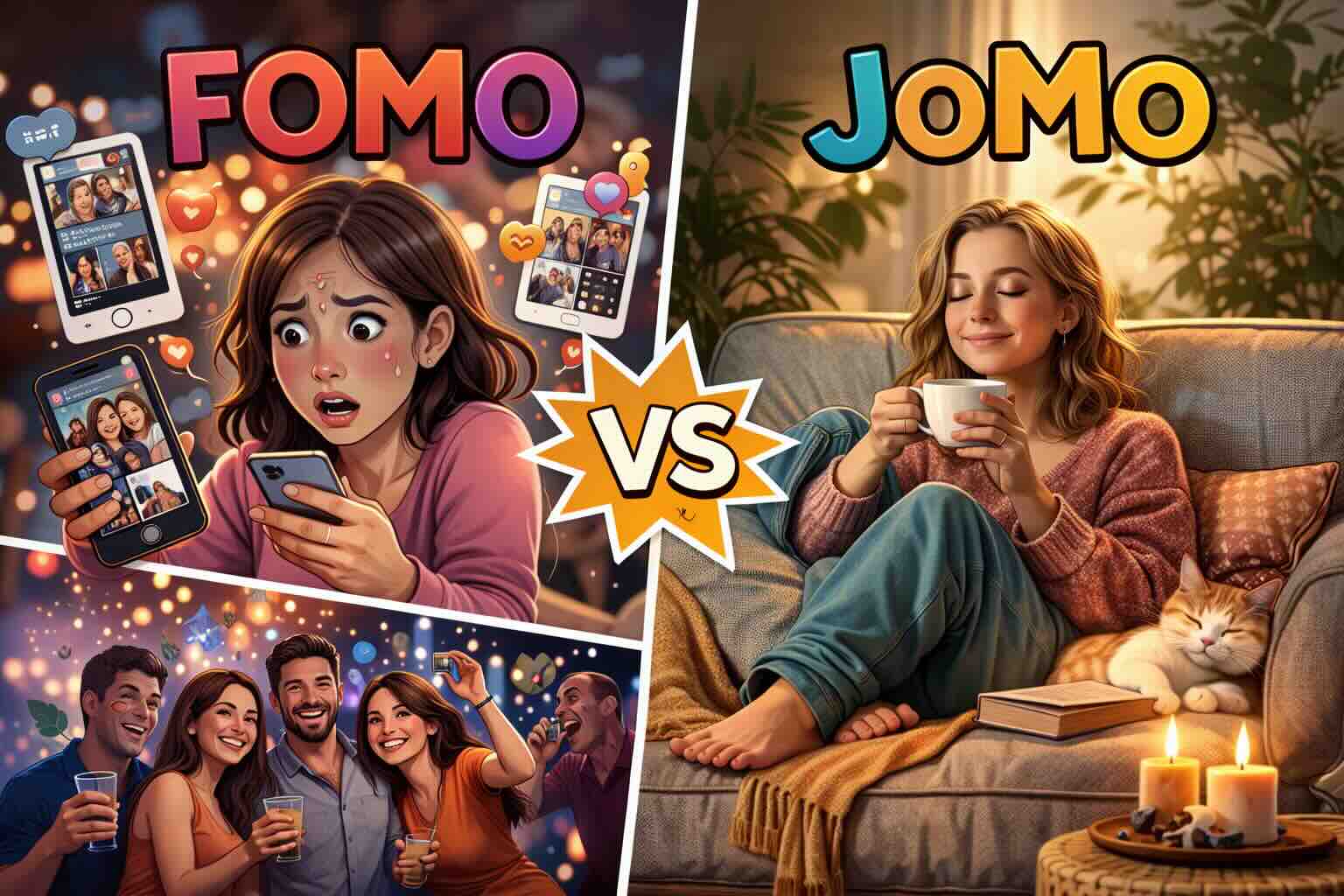
FOMO is the emotional equivalent of standing outside a party, nose pressed to the window, except now the party follows you everywhere. You’re at dinner, and suddenly your phone buzzes: friends are at a rooftop bar with string lights and suspiciously perfect lighting. You’re at home watching a perfectly respectable show, and somehow it feels like you’ve chosen incorrectly. FOMO whispers, “You could be elsewhere. You should be elsewhere. Everyone else is elsewhere.”


Of course, “elsewhere” is often curated nonsense. Nobody posts the long Uber ride, the awkward small talk, or the moment someone spills a drink on their shoes. Social media is a highlight reel, and yet FOMO convinces us it’s a documentary. And so we chase. We overbook. We say yes to things we don’t actually want to do because the alternative—missing out—feels worse. We become collectors of experiences rather than participants in them. It’s not enough to go to dinner; it has to be the right dinner, with the right people, at the right place, preferably photographed from above.
Then, quietly, almost rebelliously, along comes JOMO: the “joy of missing out.” JOMO is not flashy. JOMO does not trend. JOMO is the friend who says, “You know what? I’m good.” JOMO is choosing to stay home on a Friday night and feeling—not guilty—but relieved. It’s turning down an invitation without drafting a complicated excuse. It’s understanding that life is not a competition for most events attended.
Imagine two scenarios. In the first, you attend a crowded party where you know three people, shout over music, and check your phone every eight minutes. In the second, you sit on your couch, order takeout, and watch a movie you’ve been meaning to see. FOMO insists the first is superior. JOMO gently suggests the second might actually be better. JOMO is not about becoming a hermit (though hermits probably have excellent sleep schedules). It’s about intentionality. It asks a radical question: “Do I actually want to do this?” Not “Will this look good?” Not “Will I regret missing it?” Just: “Is this for me?”
Consider the phenomenon of the “optional event.” You’re invited. It’s not mandatory. You hesitate. FOMO jumps in: “What if something amazing happens?” JOMO counters: “What if nothing amazing happens, and you lose two hours and your parking spot?” Suddenly, the decision becomes clearer.


There’s also a strange freedom in realizing that you are, in fact, missing out on things all the time—and that’s okay. You can’t be everywhere. You can’t do everything. Even the most socially active person is, at any given moment, missing a better brunch somewhere. JOMO embraces this reality and shrugs. It says, “Yes, that concert looks fun. But so does being in pajamas by 9:30.” It finds satisfaction not in maximizing options, but in choosing well among them. Ironically, JOMO often leads to richer experiences. When you’re not mentally comparing your current activity to a dozen hypothetical alternatives, you’re more present. Dinner tastes better. Conversations go deeper. Even doing nothing feels like something.
This isn’t to say FOMO is entirely bad. A little curiosity, a little willingness to try new things—that’s healthy. FOMO, in small doses, can push us out the door when we’d otherwise stay in indefinitely. But left unchecked, it becomes exhausting. It turns life into a constant audit of what you could be doing instead of appreciating what you are doing. The sweet spot lies somewhere in between: a life where you occasionally say yes out of curiosity, but often say no out of clarity. Where you can scroll past someone else’s highlight reel and think, “Good for them,” rather than, “What am I doing wrong?”
In the end, FOMO is driven by scarcity—the idea that you’re missing something essential. JOMO is grounded in abundance—the belief that what you have, right now, might be enough. And if that means missing a party now and then? Well, there’s always another one. Or, better yet, there’s always your couch.
My take: With AI, the paragraphs are too long, and there is no personal context to share any examples beyond the generic. On the positive side, AI is becoming cleverer and wittier when prompted.
John Fletcher is CEO/Founder of Fletcher Consulting Public Relations in Arlington, where he is a master at connecting friends and clients with important resources and composing award-winning nominations. Contact him at john@thefletch.org
