


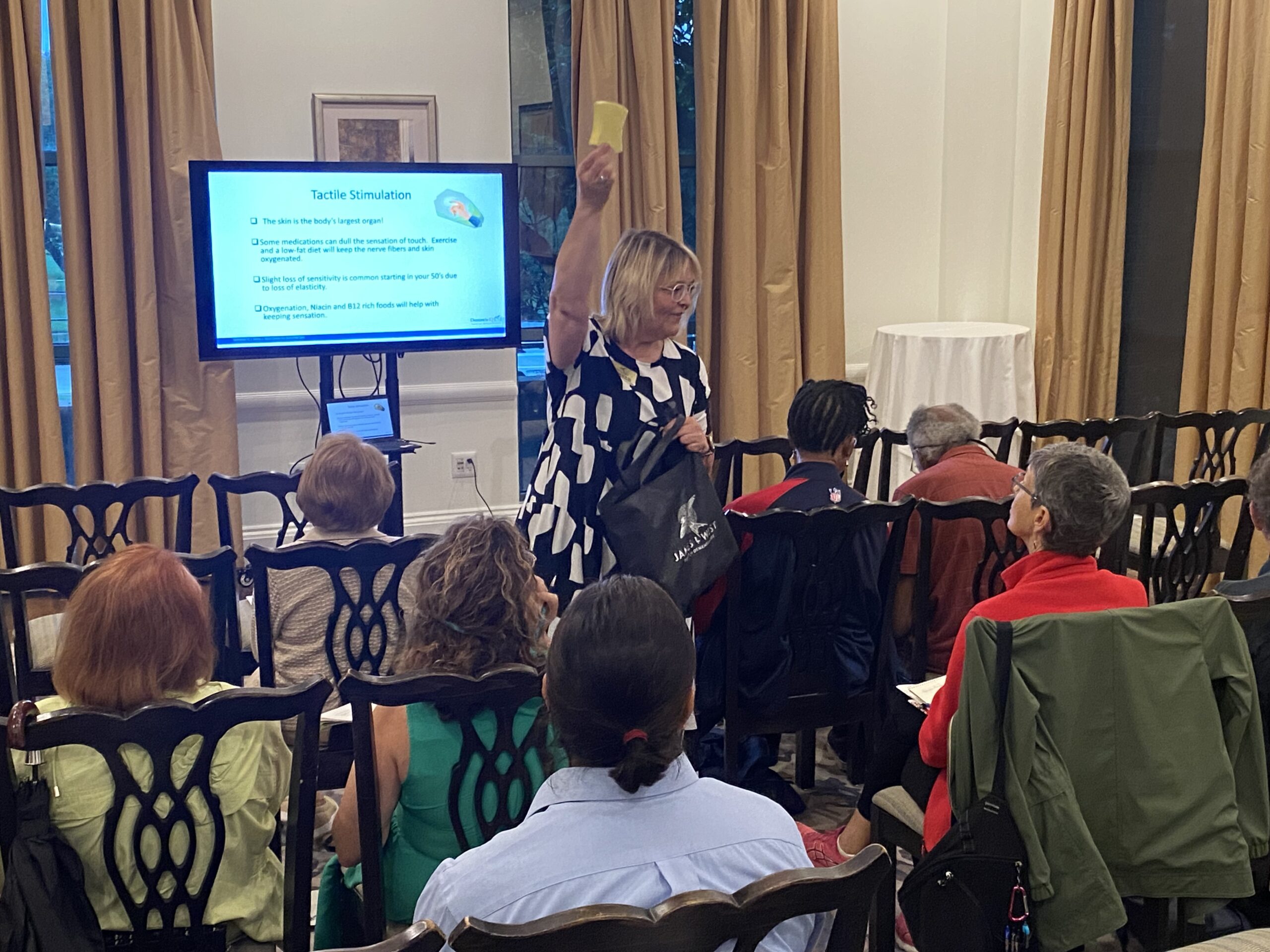

An enthusiastic audience discovered simple strategies and exercises to improve the health and vitality of their brains on Tuesday, May 19, at River Crest Country Club.
Jaime Cobb Tinsley, Vice President of Family & Professional and Education, and Hollie Lowe, Director of Education and Family Support at the James L. West Center for Dementia Care, shared practical insights to keep brains and bodies healthy. As Tinsley shared, “Brain health is something we should all take seriously. Simple habits like eating foods that support heart and brain health, continuing to learn new things, making quality sleep a priority, and staying socially connected can make a real difference over time.”
She added that the goal for the event was to help people better understand brain health and ways to reduce their risk for dementia while also giving them the chance to experience fun activities that challenged their thinking and engaged different parts of the brain. One of the early signs impacting seniors is hearing loss, because with its gradual decline, many people do not recognize their hearing challenges. Its estimated that one in seven Americans experience hearing loss, and many may not have noticed it.
Hearing loss becomes more than an ear issue; it is a brain health issue that can serve as an early warning sign because sound may start in the ear, but it lives in the brain. When hearing begins to decline, the brain starts to receive less stimulation, which results in structural brain changes.
Dr. Robin Carson, Doctor of Audiology at Carson Hearing Center, who spoke at the event, shared that “Untreated hearing loss can more than triple a person’s dementia risk. “A 2020 research project identified hearing loss as the single largest modifiable risk factor for dementia.”
In the study, Johns Hopkins tracked nearly 640 adults over 12 years and discovered that people with mild hearing loss had double the risk of developing dementia. Meanwhile, moderate loss tripled that risk, and severe loss increased the risk fivefold.
Identified risk factors include heavy alcohol use, smoking, higher or low untreated blood pressure, head injury, depression, chronic stress, obesity, and diabetes.
“What can we do to stay autonomous, independent, live life to the fullest, and engage in life?,” Tinsley asked the audience.
She joined Hollie Lowe in sharing that the most effective ways to “age healthy” and reduce risk of dementia are:
- Exercise
- Quality sleep
- Manage stress
- Stay socially connected
- Brain fitness
- Diet
- Exercise: Combining aerobics and strength training 30 minutes per day, six days per week increases cellular function
- Quality sleep: Allowing your body to switch into a state that clears its waste products while processing and storing emotional memories and releasing chemicals that strengthen your immune system
- Manage stress: Regulating your heart rate, brain activity, digestive system, muscle tension, and immune system, particularly following a day that may have included tension or stress
- Social connectivity: Engaging in conversations helps stimulate your brain by focusing on attention, memory, and thinking on your feet, as well as the joy of building relationships
- Brain fitness: Cross-training your brain through problem solving, novelty, variety, and constant challenge
- Diet: Maintaining a cognitively healthy diet such as the Mediterranean diet or MIND (Mediterranean Intervention for Neurodegenerative Delay) that focus on plant-based options such as berries, nuts, avocados, and fatty fish while limiting foods that promote early aging, such as processed foods and red meat.
Tinsley and Lowe demonstrated Neurobics – the science of brain exercise, which is designed to help your brain stay fit. The concept encourages people to participate in Memory Maps, exercises that take them back to moments in happy times that help them relive details and memories.
The exercises included being blindfolded and identifying items by touch and smell, which are two of a person’s most powerful senses.
A final exercise asked participants to close their eyes and, without counting, estimating when three minutes had expired. Measuring this sense of time awareness helped activate a different style of brain awareness.
Whole Person Wellness = Healthy Brain = Aging Optimally
About the James L. West Center for Dementia Care For 33 years, the James L. West Center for Dementia Care, a not-for-profit organization, has served those impacted by dementia. Established by Eunice West in honor of her late husband, James L. West, who passed away from dementia, the Center continues to build on its excellence in compassionate care and caregiver and dementia education by expanding its service lines to meet the community’s needs. The Center offers residential care, a Senior Day Program, Short-Term Respite Care, Short-Term Rehabilitation, Home Care, and professional and family caregiver education, which was recently rebranded as Dementia-IQ Powered by James L. West.