



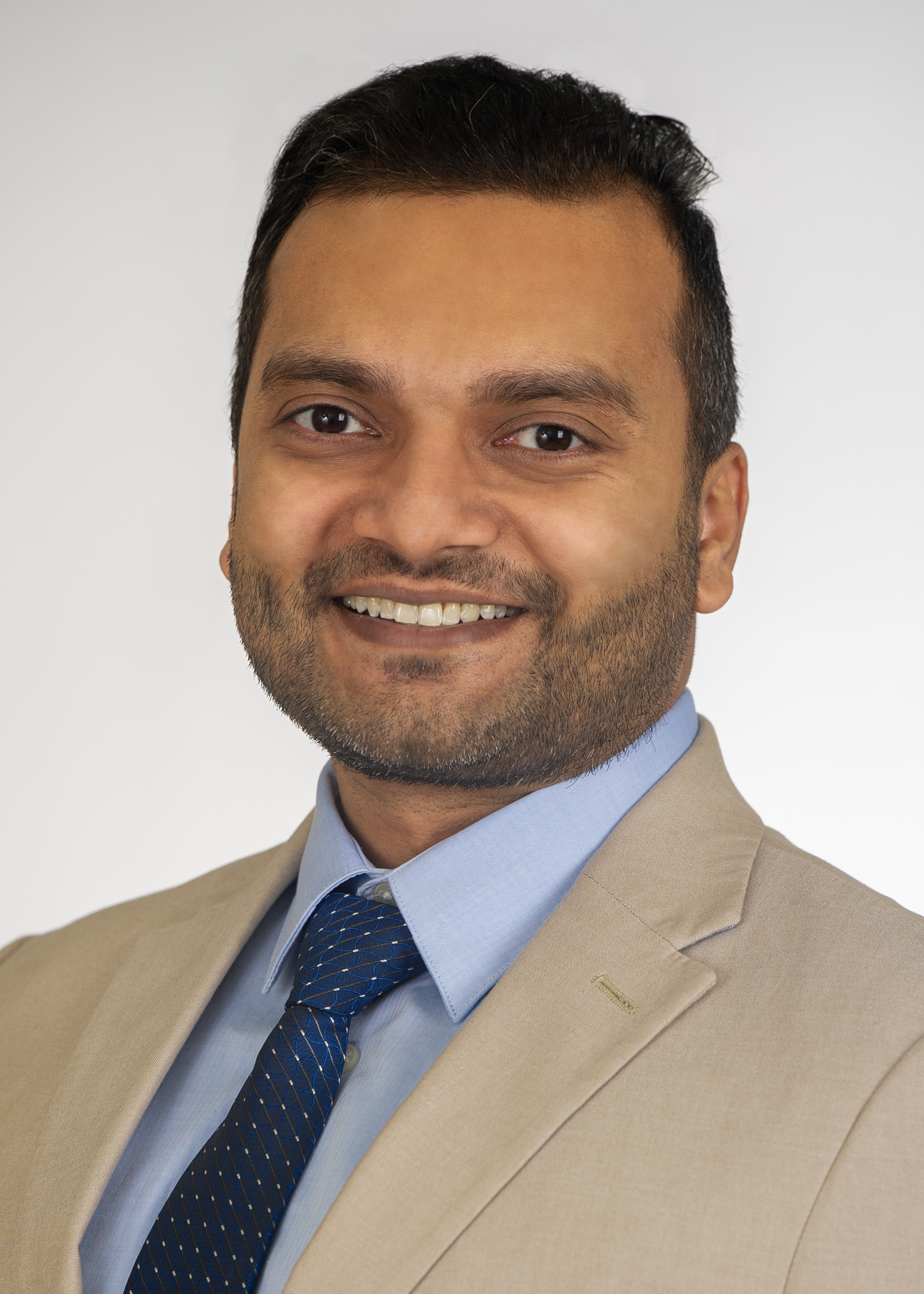
Dr. Shivam Mehta, clinical assistant professor in orthodontics at Texas A&M University College of Dentistry, and other faculty members will study mini-screw-assisted rapid palatal expander types and techniques on 40 patients in Dallas-Fort Worth.
Dr. Shivam Mehta, clinical assistant professor and program director in orthodontics at Texas A&M University College of Dentistry, recently received a $40,000 grant to study jaw expander types and techniques in teens and young adults undergoing orthodontic treatment. The American Association of Orthodontists Foundation grant will enable Mehta to evaluate two standard mini-screw-assisted rapid palatal expander protocols for reshaping narrow jaws to determine which treatment design is most effective. Studying patients ages 15 to 25 in both A&M Dentistry’s clinic and in private practices in Dallas-Fort Worth, he will research bone-anchored MARPE against hybrid MARPE that anchor expanders to bone and teeth.
“Which one orthodontists use is often dependent on where they studied, continuing education they received and what they feel comfortable using,” Mehta said. He said bone-anchored MARPEs tend to lead to higher stress on palatal mini screws, while the hybrid technique puts higher stress on molars. Part of the study will research how each treatment affects the jaw and jaw structures. Mehta, who joined A&M Dentistry in 2024 from Marquette University School of Dentistry, said this could be among the first studies of MARPEs since their introduction in 2010. The study could affect millions of patients’ treatment plans.
Posterior crossbite, in which the upper molars and premolars sit inside their lower counterparts, causing misalignment, is a common reason for teens and adults to require MARPEs. Mehta said previous studies showed that 14%-20% of the global population has a posterior crossbite, and that correcting a crossbite is easiest in young children because their jaws are still growing and more malleable; traditional expanders are most effective in such cases.

However, as more adults seek orthodontic care, MARPEs are necessary to help many avoid surgery to expand narrow maxillary jaws. Roughly one in three orthodontic patients is an adult, according to the American Association of Orthodontists. Some simulation studies have found bone-anchored MARPEs more advantageous for adult patients with periodontal disease, but Mehta noted that further study is necessary. Mehta further stated that a high percentage of his patients at A&M Dentistry and in private practice are adults. Plans are to study 20 patients with bone-anchored expanders and 20 with hybrid expanders.
Patients have not yet been selected, but the pool will include A&M Dentistry patients and patients at both myKIDSdds in Dallas and Jolley Orthodontics in Trophy Club. Dr. Glenn Cohen, an orthodontist at myKIDSdds, and Dr. Cameron Jolley, an orthodontist and the owner of Jolley Orthodontics, are part-time clinical faculty members at A&M Dentistry. Mehta’s private practice isn’t part of the study.
Screening at A&M Dentistry will likely begin in the spring, Mehta said. Those chosen will be new patients who haven’t had orthodontic treatment. “We have a tendency in our office to use a hybrid tooth/bone-borne MARPE because there is no clear evidence that one is superior to the other,” Jolley said. “This study will answer relevant clinical questions regarding this technique, which should improve outcomes for our patients.”
Mehta said MARPEs can help adults of all ages, but the study will focus on adolescents and young adults because their palates have begun to fuse but remain flexible. Patients will be studied for six months. Future research may include studying older age groups.


“I hope to have the first results by early next year,” he said. “Potentially, a second study could look at the long-term outcomes – possibly as long as two years – and bring in some of the same patients.”
Texas A&M University College of Dentistry Texas A&M University College of Dentistry (formerly Baylor College of Dentistry) in Dallas is a part of Texas A&M University and Texas A&M Health. Founded in 1905, the College of Dentistry is a nationally recognized center for oral health sciences education, research, specialized patient care and continuing dental education. Learn more at dentistry.tamu.edu and follow @TAMUdental.
